


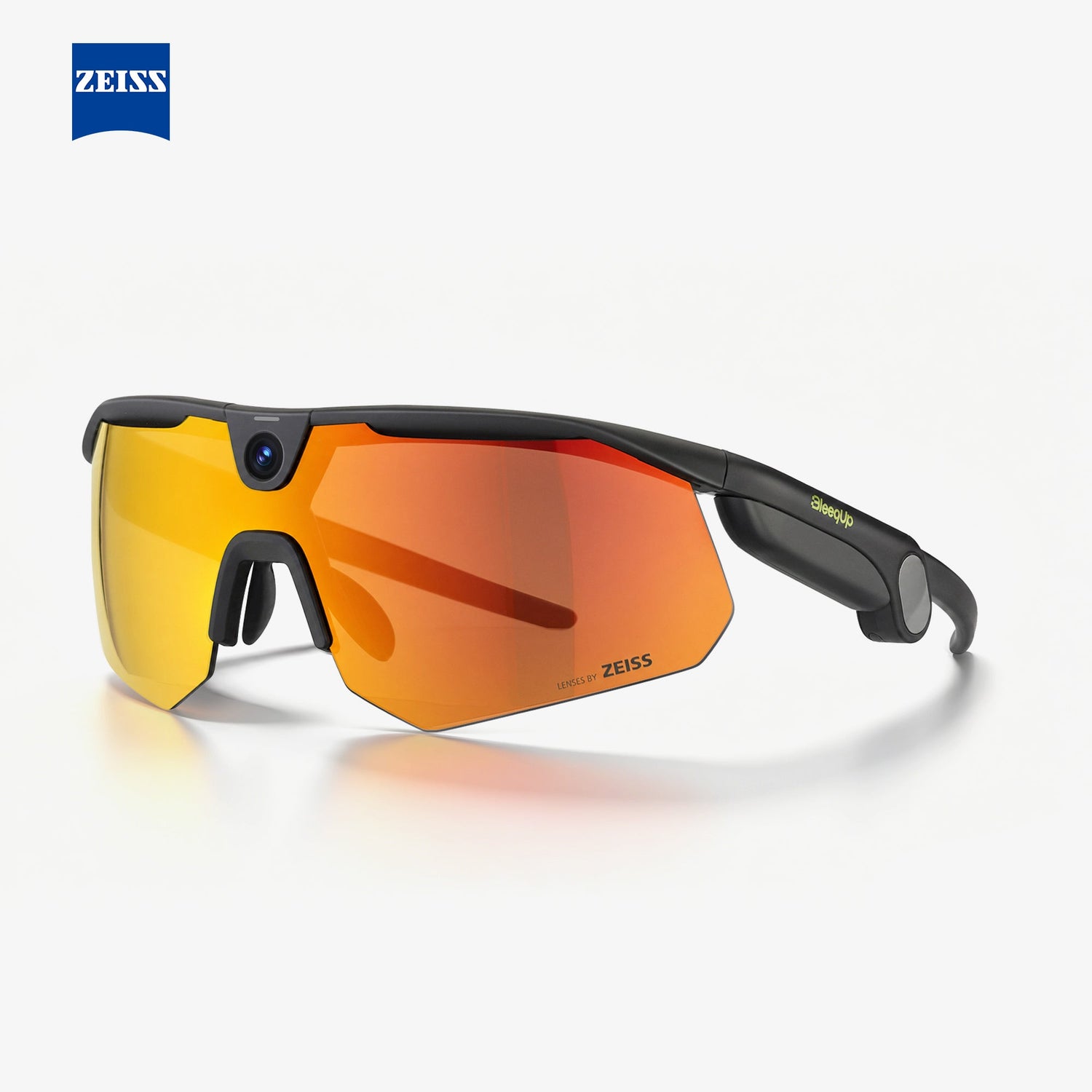
Recording glasses put a camera in the frame of a pair of sunglasses, so the footage comes from your own line of sight. No helmet mount, no chest strap, no phone held out in front of you. You look, you tap, you record.

The term now overlaps with AI glasses, which split two ways: smart glasses with a display for notifications and translation, and AI glasses with a camera for hands-free video. Recording glasses are the second kind, built around the lens and the stabilization rather than a screen. If you are shopping for recording glasses this year, the useful question is not which one has the most megapixels. It is which one you will actually wear and actually get footage out of.
What to look for
Four specs separate recording glasses you keep from recording glasses that end up in a drawer.
Stabilization
This is the one that decides whether the footage is watchable. A camera at eye level moves with your head, so without electronic image stabilization the result is shaky. Check for EIS before you check resolution.
Open-ear audio
If the glasses block your ears with earbuds, you lose the awareness that makes them safe for running and cycling. Open-ear speakers let you hear music, calls, and directions while still hearing traffic.
Battery and storage
A short recording window means you plan your day around the glasses instead of the other way. Look at both the built-in battery and whether there is an extension option, plus how much video the storage holds.
The app
The footage has to go somewhere. An app that imports the clips, runs AI highlights, and handles the editing is the difference between posting the ride and never watching it.
Glasses that record: what the phrase actually covers
"Glasses that record" and "glasses that record video" describe the same object as recording glasses, and the wording matters less than the distinction underneath it. A pair of glasses that records has to hold three things inside a frame that also has to sit on your face: a camera sensor, a battery, and enough electronics to write a file. That is why the category splits by what gets sacrificed rather than by what gets added.
Glasses that can record but put the camera in the temple arm save space along the brow and look more like ordinary eyewear, at the cost of a slightly off-axis view — the footage comes from beside your eye instead of from it. Glasses that record with the camera on the bridge, which is where the Ranger sits, put the lens on your sight line. The frame reads more obviously as a camera, and the footage is the view you actually had.
There is also a category that is not this one. "Glasses that record" is sometimes used for covert cameras built into ordinary frames. Those are a different purchase with different legal exposure, and nothing on this page applies to them.
Filming glasses and video glasses: same product, different searches
"Filming glasses", "video glasses" and "video recording glasses" are searches for the same thing with different expectations attached. People searching for filming glasses usually want to know whether the footage is usable at all — whether a camera on your face produces something you would show anyone. People searching for video glasses are often looking for a display, which is a different product entirely.
That second confusion is worth clearing up, because it is the reason some buyers end up disappointed. Video glasses in the display sense put a screen in front of your eye for watching content. Video recording glasses put a camera in the frame for capturing content. The Ranger is the second kind: there is no display, and the entire design budget goes into the sensor, the stabilization and the frame weight instead.
The honest answer to whether filming glasses are usable is that stabilization decides it. A head-mounted camera moves with every step and every bump, so without electronic image stabilization the result is footage nobody watches. With it, a 3K 60fps capture from eye level is close enough to a handheld gimbal shot that the difference stops mattering for social clips — which is the format almost all of this footage ends up in.
Camera sunglasses and POV camera glasses: the same trade, two names
Camera sunglasses emphasises the lens; POV camera glasses emphasises the view. Both describe a pair of sunglasses that records from your eye line, and both involve the same trade: you give up lens choice and some image control in exchange for a camera that is already pointed wherever you look.
That trade is worth taking when the alternative is no footage at all. It is a bad trade when you want a specific shot, because a camera on your face cannot be framed — it can only be aimed by turning your head. For planned filming, a camera on a tripod still wins. For the thing that happens while both your hands are busy, POV camera glasses are the only option that does not require you to stop.
Lens choice is the part buyers underestimate. A dark mirrored lens is the right call in bright sun and the wrong one at dusk, and unlike regular sunglasses you usually cannot swap it for a clear lens mid-ride. Check what the lens does in the light you actually ride in before comparing anything else.
Recording glasses vs action cameras
An action camera still wins for planned, multi-angle filming where you set up the shot and want maximum stabilization and the largest accessory ecosystem. Recording glasses win for capturing what you actually look at, with zero setup.
The tradeoff is honest. You give up some raw image control to gain a first-person view that follows your attention. If your goal is a shareable clip of the ride rather than a film, the glasses are usually the more practical tool because they remove the friction of mounting, aiming, and sorting.
The BleeqUp Ranger as a recording glasses pick
The Ranger is a sports camera glass, which means the camera is the point rather than an afterthought. It records 3K at 60fps with a 16MP photo mode across a 120-degree field of view, and it adds electronic image stabilization to keep the footage steady on rough ground.
The frame is 49 grams of TR90, light enough to wear for a full ride without the pressure points you get from heavier wearables. Audio runs through four open-ear speakers and a five-microphone array with wind-noise reduction effective to about 40 km/h, so you can take a call and still hear the road.
Battery is a 260 mAh cell for about an hour of continuous video, and the Power Plus accessory extends that to roughly five hours. Storage is 32GB, which holds about four and a half to five and a half hours of footage. The IP54 rating covers sweat and light rain, and the UV400 lens handles bright sun.
Two tiers sit in the lineup. The standard model is $379 in black with an orange-red lens, white with a gold lens, or pink purple with a pink-purple lens. The premium version at $439 uses Carl Zeiss co-branded lenses in Zeiss Orange or Zeiss Blue Gold. Both include a free RX lens insert for prescription wearers (the prescription lens fitting is a separate service).
On the app side, the BleeqUp app imports the footage, handles One-Tap Clip and AI Highlights, and pairs with Strava and Garmin sensors for ride data overlays.
FAQ
What are the best recording glasses?
For sports and hands-free first-person video, the BleeqUp Ranger is a strong pick because it combines a stabilized 3K camera, open-ear audio, and AI editing in a 49-gram frame. The right choice depends on whether you prioritize sports durability or a lighter lifestyle design.
Are recording glasses legal?
In most places, recording in public is allowed, but rules vary by country and by context. If you record other people or private property, check local laws before sharing the footage.
How long do recording glasses record?
The Ranger records about an hour of continuous video on its own and up to five hours with the Power Plus accessory. Storage is 32GB.
Can you listen to music on recording glasses?
Yes. The Ranger uses open-ear speakers, so you hear music and calls without blocking your ears to traffic and surroundings.
Do recording glasses work with prescription lenses?
The Ranger includes a free RX insert with every purchase, so you can have your prescription fitted and still use the camera.
What is the difference between filming glasses and video glasses?
Filming glasses and video recording glasses capture footage through a camera in the frame. Video glasses usually mean a display that shows you content. If you want to record rather than watch, you want the first kind.
Compare the full BleeqUp Ranger lineup and read our camera glasses for cycling buying guide if you want to narrow it down by sport.
Related reading: what recording camera glasses are, sports glasses buying guide, the best camera glasses guide, and smart glasses with a camera compared.


